
The Forgotten Blueprint: How Black America Built Its Own Economy from 1800–1965

Through historical analysis and contemporary data, The Forgotten Blueprint argues that the path forward does not lie in grievance, dependency, or symbolic inclusion. It lies in restoring the principles that once sustained Black prosperity: faith, family, education, land ownership, disciplined economics, and institutional accountability.

$25.00

Out of stock

About The Author

Damon K. Jones

Damon K. Jones

Damon K. Jones is a publisher, political commentator, and community advocate dedicated to reshaping the economic and political conversation within Black America. As the founder of Black Westchester Magazine, he has built a platform focused on accountability, ownership, and outcome-based leadership in local and national politics.
Jones is the author of multiple works examining the intersection of history, economics, faith, and political power. His writing challenges dependency politics, critiques institutional failures, and calls for a sovereignty-minded approach to community development rooted in ownership, discipline, and strategic thinking. Drawing inspiration from historical scholars such as Carter G. Woodson, Frederick Douglass, Dr. Claude Anderson, and Dr. Amos Wilson, his work blends historical analysis with practical frameworks for economic empowerment.
He works closely with Blacks in Law Enforcement of America, engaging issues surrounding public safety, constitutional rights, and the relationship between Black communities and law enforcement. His commentary consistently emphasizes logic, measurable outcomes, and institutional responsibility over rhetoric and partisan loyalty.
Beyond publishing, Jones produces multi-platform media content spanning print, video, and digital formats, consistently advocating for economic independence, leadership accountability, and cultural clarity.
At the core of his work is a simple but uncompromising message: political access is not power — ownership is.

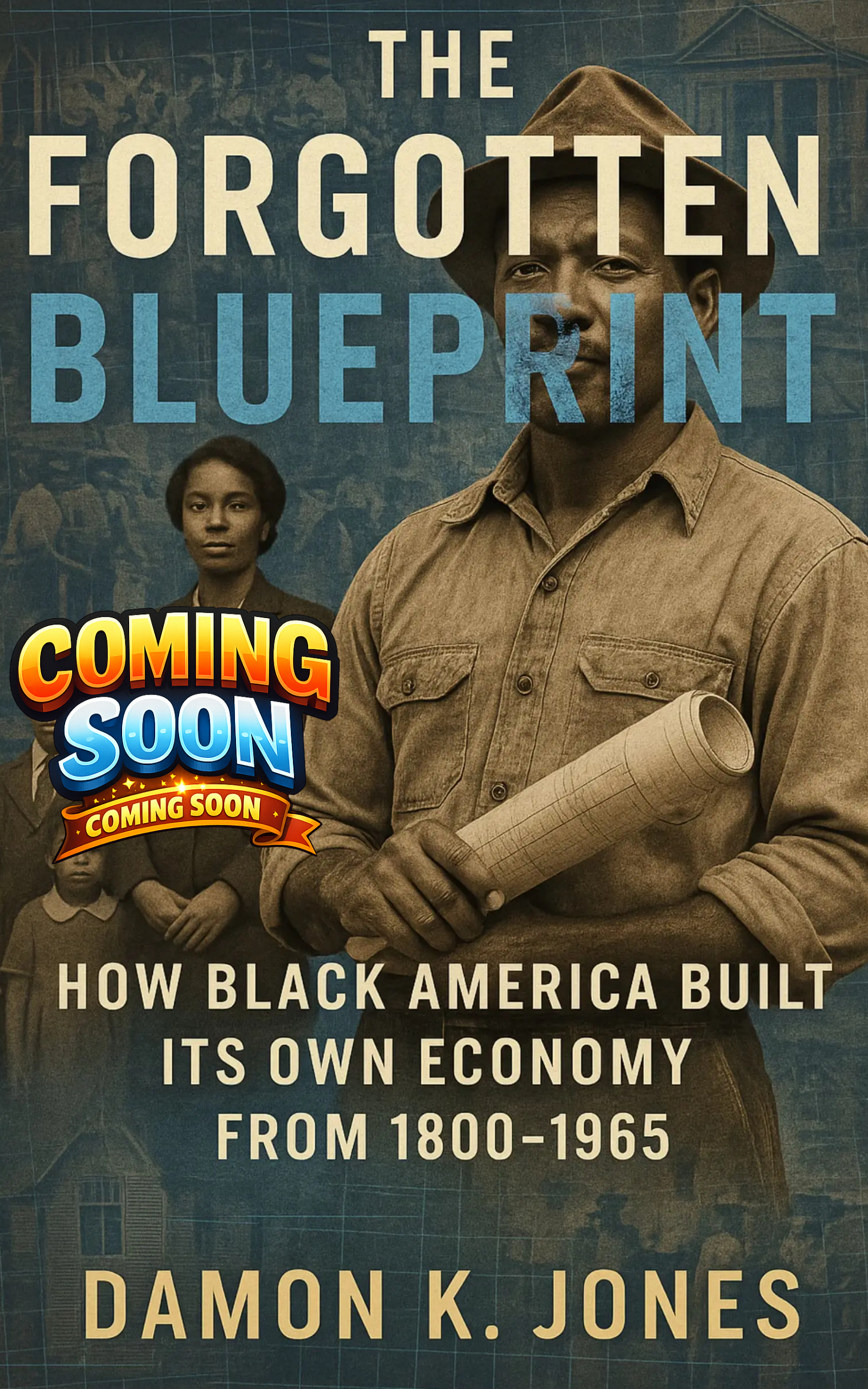
The Forgotten Blueprint: How Black America Built Its Own Economy from 1800–1965

For over a century, Black Americans built thriving communities under the harshest conditions imaginable. They built businesses under segregation. They built schools when they were denied resources. They built banks when they were excluded from capital. They built strong families rooted in faith, discipline, and ownership.

Then something changed.

In The Forgotten Blueprint, Damon K. Jones challenges the modern narrative that Black progress depends on political access or government intervention. Drawing on historical records, economic data, and policy analysis, this book reveals how Black America once achieved economic growth, rising literacy, strong two-parent households, and expanding land ownership — long before federal inclusion.

From Reconstruction to the Civil Rights era, Black communities built parallel institutions that sustained dignity and independence. But integration, shifting incentives, political realignment, and cultural reorientation gradually dismantled that internal economic ecosystem.

This book asks uncomfortable but necessary questions:

• Why were Black family structures stronger in 1900 than they are today?
• Why did Black business districts decline after legal equality was achieved?
• Why has political representation increased while economic sovereignty has weakened?
• Did integration expand opportunity while dissolving ownership?

This is not a book about nostalgia. It is a book about outcomes.

Through historical analysis and contemporary data, The Forgotten Blueprint argues that the path forward does not lie in grievance, dependency, or symbolic inclusion. It lies in restoring the principles that once sustained Black prosperity: faith, family, education, land ownership, disciplined economics, and institutional accountability.

We were never powerless.

We were builders.

The blueprint still exists.

The question is whether we have the courage to use it.

Reviews

There are no reviews yet.

Be the first to review “The Forgotten Blueprint: How Black America Built Its Own Economy from 1800–1965”

Your email address will not be published. Required fields are marked *